

01 — AutoScout24 · SMG
Vehicle management
Dealers 4.17 → 5.1 · Private 4.7 → 5.12
A vehicle inventory for 10 to 150 vehicles — built for efficiency and customer satisfaction, with prices, performance and status where dealers work every day.
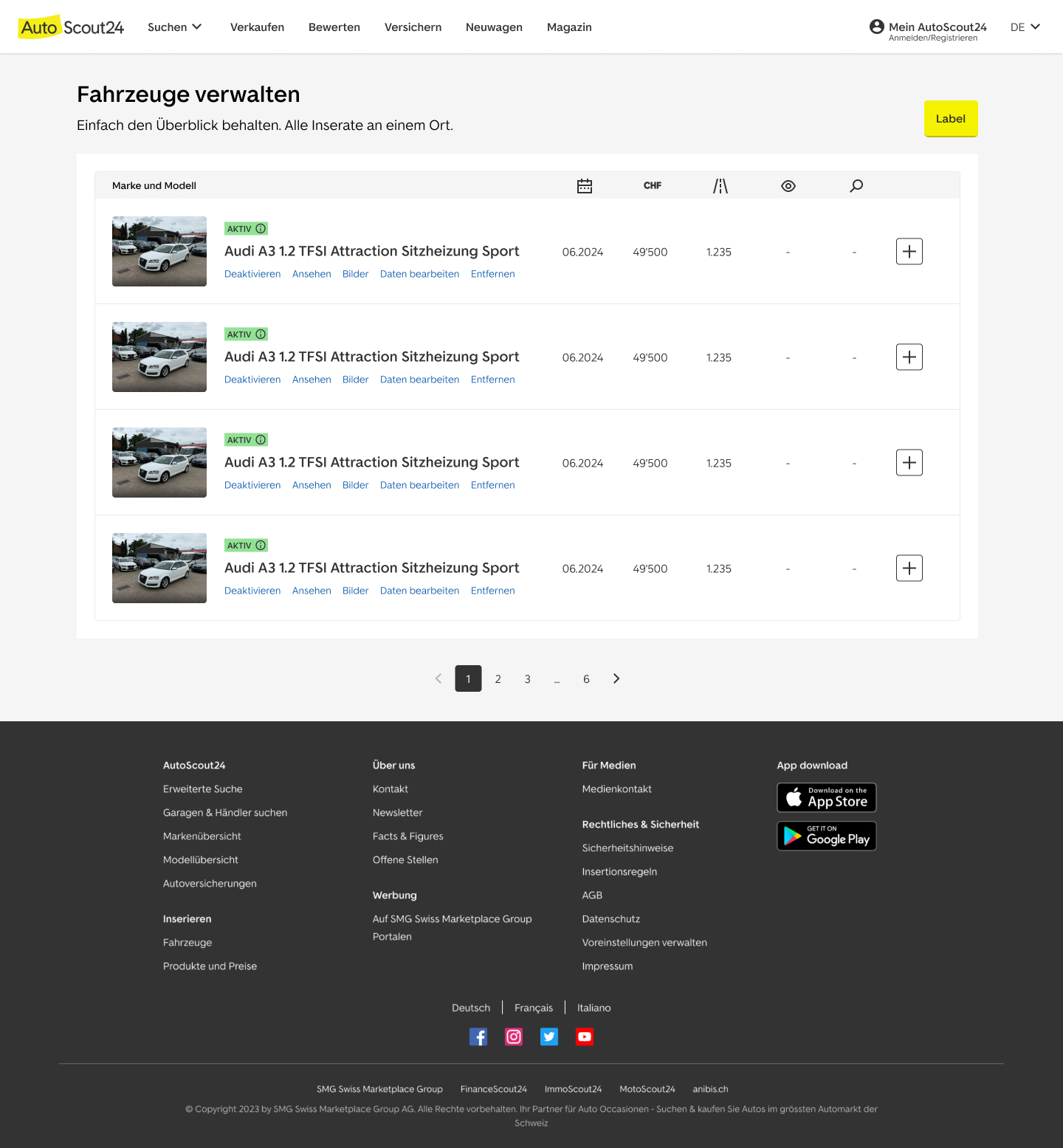
List view: inventory, status and core actions in one surface.
- Role
- UX research & product design
- Timeline
- SMG · AutoScout24 Switzerland
- Duration
- Platform rebuild
- Team
- Product, engineering, research
- Platform
- Web · b2b.autoscout24.ch
4.7 → 5.12
HaTS private, 12 months
4.17 → 5.1
HaTS dealers, 6 months
20
Interviews, tests, workshops
Context
A rebuild as a chance, not a rewrite.
The previous vehicle manager sat on a dated codebase and was dealers’ daily tool. The platform rebuild was the moment to lift it technically — and recut the work itself. Audience: professionals with 10 to 150 vehicles, moving price, performance and status several times a day.
Problem
Three tensions the old tool never resolved.
- 01
One surface for two extremes
Small lots need calm. Large lots need density. Two products would be expensive — and would split the organisation.
- 02
The work lived in the listing, not the list
To change a price, read performance or switch status, every vehicle had to be opened. Daily work was a click marathon.
- 03
Features without priority
Edge cases grew faster than core tasks. Without a clear IA, every new field became friction.
What we did not build
What was on the table — and what we left.
- 01
One product, not two worlds
Small lots need calm, large lots need density. Two tools would have split the organisation. We built one surface that holds both.
- 02
The work stays in the list
No side flow where every vehicle has to be opened to move price, performance or status. Daily work happens in the overview.
- 03
Core before edge case
Fields that do not carry daily work were cut. Better a clear IA than a form that absorbs every edge-case field.
Role
End-to-end UX, in parallel with the rebuild.
I planned and ran the research, sorted the information architecture with dealers, built wireframes and prototypes, and stayed close to engineering through implementation. No waterfall: design and code moved in the same rhythm.
- Research plan: 20 sessions across interviews, usability tests and design thinking
- IA, flows and iterative prototypes in Figma
- Close work with product and engineering during the rebuild
Process
From 20 sessions to a surface.
- 01
Research
20 sessions: user interviews, usability tests and design-thinking methods. Ask about the day, not the feature.
- 02
Card sorting
How dealers group vehicles in their heads became the information architecture.
- 03
Wireframes
Lo-fi first, validated with dealers before hi-fi narrowed the conversation.
- 04
Prototype & tests
Clickable prototypes for the core jobs: price, performance, status.
- 05
Rebuild
Iteration in parallel with the technical rebuild. Specs engineering could actually ship.
Insight
The list is the product.
Dealers want to move price and performance in the overview — not disappear into the listing.
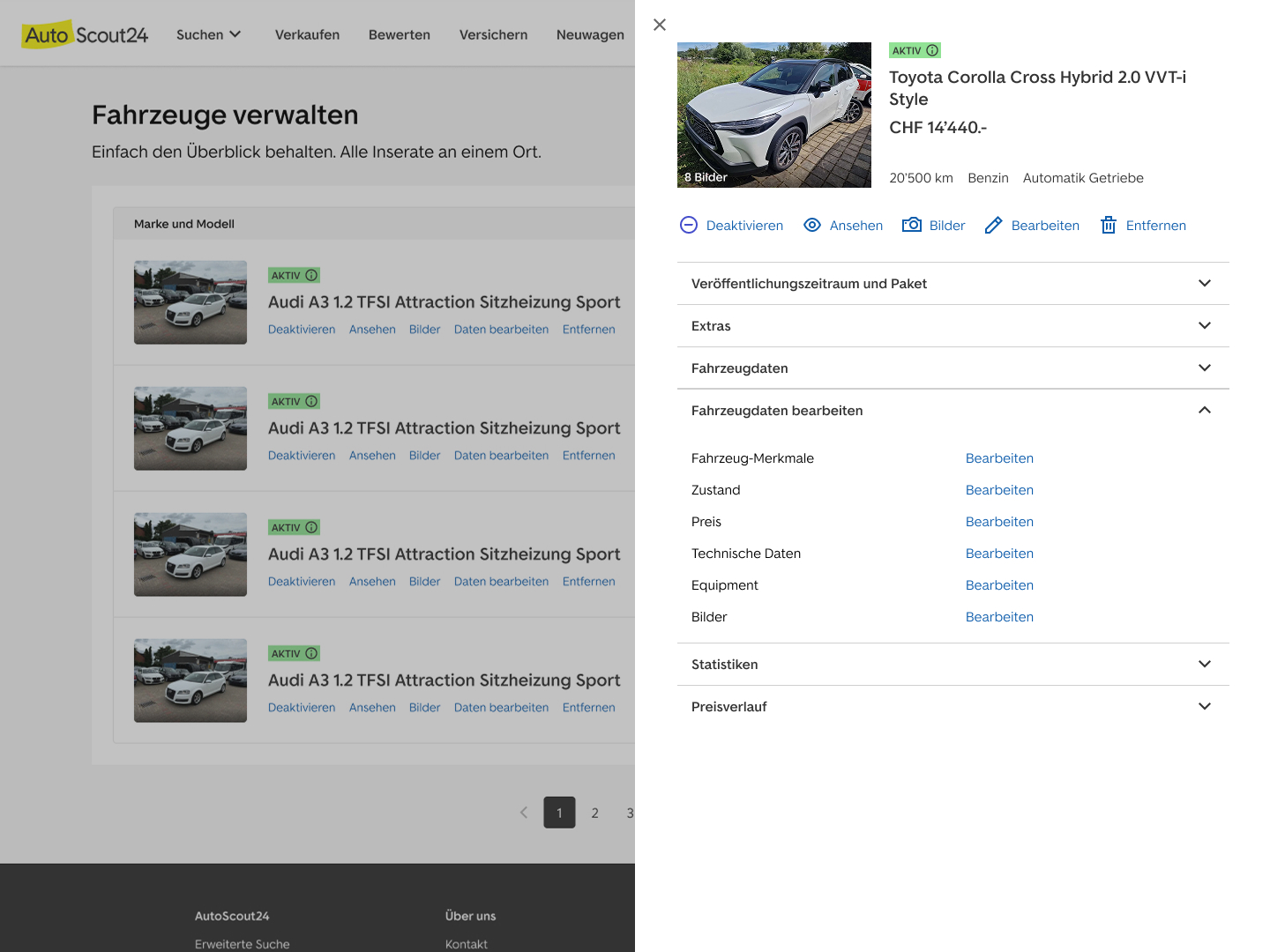
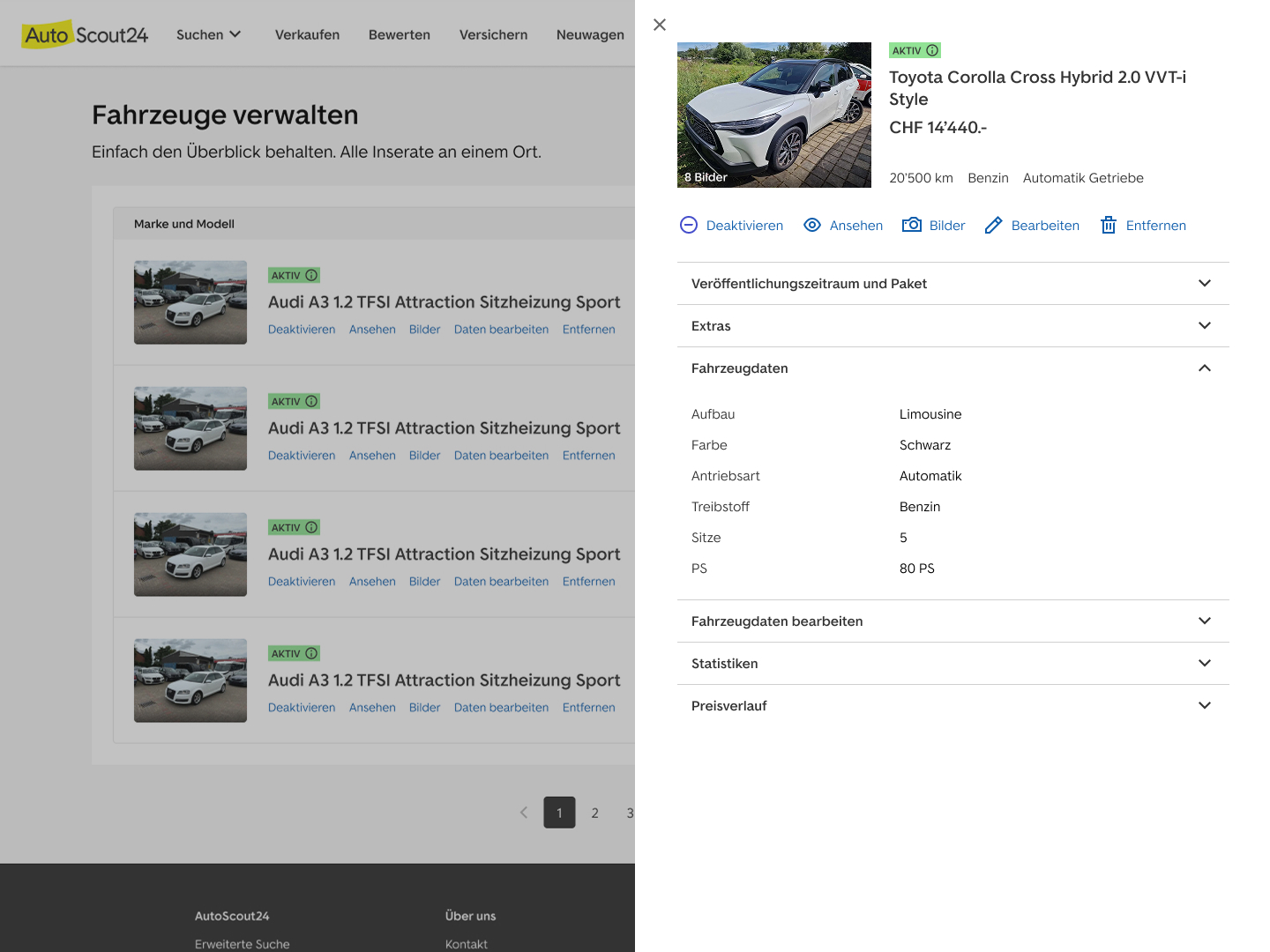
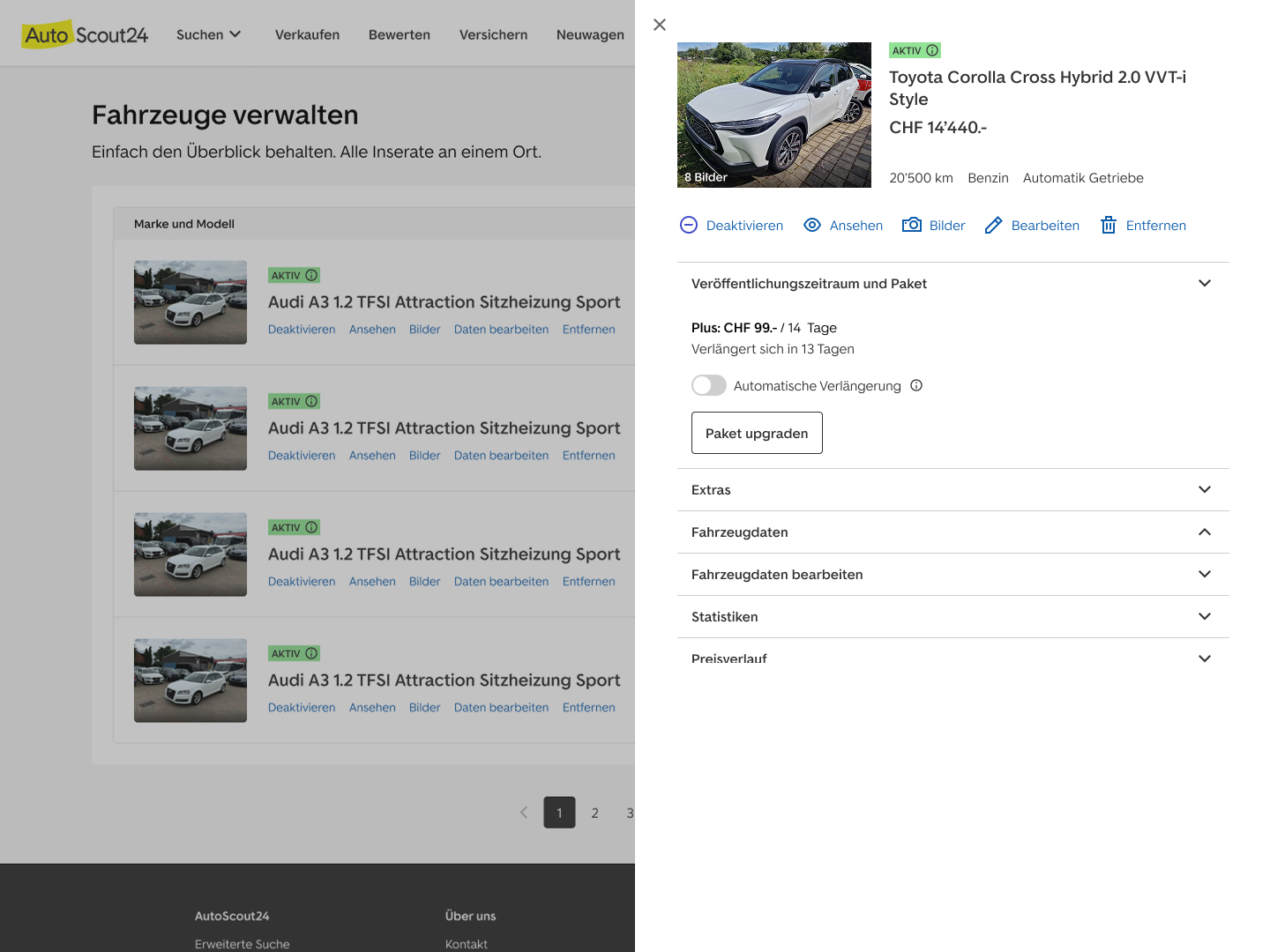
Card sorting and interviews showed the same pattern: the inventory view is not a directory. It is the workplace. Filters, inline edit and a detail panel that does not break the flow were not features — they were the solution.
Solution
One surface that grows with the lot.
Instead of separate views for small and large: one scalable list. Strong filters, direct editing of the fields that run the day, and a detail panel for depth without losing context. A lighter private-seller version was later derived from the same structure — a sign it held.
Impact
Satisfaction after launch. Efficiency you can measure.
The manager was built for efficiency and customer satisfaction — HaTS confirmed it after launch on 16 September 2024. Private sellers: 4.7 before release, 5.08 after three months, 5.12 after a year. Dealers: 4.17, then 4.81 after three months and 5.1 after six months in 2025. Daily moves — price, performance, status — got shorter. The cockpit on b2b.autoscout24.ch is now the central working tool.
4.7 → 5.12
HaTS private, 12 months
4.17 → 5.1
HaTS dealers, 6 months
20
Interviews, tests, workshops
Reflection
Keep
Research in this mix. 20 sessions — interviews, tests, design thinking — paid for the IA.
Do differently
Communicate missing launch features more clearly. Bring very large lots into testing earlier.